We’ve all been there. A new client walks in, excited for her appointment. She pulls out her phone and shows you a picture. It’s a flawless, poreless, perfectly symmetrical face, glowing with an ethereal light. It’s also completely fake. The image has been tweaked, blurred, and filtered into oblivion. “This is the look I want,” she says, full of hope.
This is the modern PMU artist’s dilemma. How do you gently bring a client back to reality without crushing her dreams or sounding negative? How do you manage expectations when their inspiration is a digital fantasy? In a world saturated with Instagram filters and one click transformations, navigating the conversation about what is achievable with permanent makeup is a critical skill. Get it wrong, and you risk an unhappy client and a potential blow to your reputation. Get it right, and you build trust, deliver beautiful and realistic results, and create a loyal client for life.
At PMU Society, we see artists grapple with this daily. We help them build the systems and confidence to handle these exact situations, turning tricky consultations into business building opportunities. Let’s break down how you can master this conversation.
The Instagram Face: When Client Inspiration is Unrealistic
The first step is understanding the scale of the problem. Social media, particularly Instagram, has created a new standard of beauty that often doesn’t exist in the real world. Filters can alter bone structure, erase skin texture, change eye colour, and create an impossible symmetry. When a client brings you a heavily edited photo, they aren’t just showing you a makeup style they like; they are showing you a fantasy.
Your job is not to replicate that fantasy. It is to translate their desire into an achievable, beautiful outcome for their unique face. The client might not even be consciously aware of how much the image has been altered. They just see a look they admire. It’s crucial to approach this with empathy but also with firm, professional authority. You are the expert. They are coming to you for your skill and judgement, not just your ability to trace a picture.
Pointing out the filter isn’t about making the client feel silly. It’s about education. Explain that skin has texture, pores, and natural asymmetries. Pigment heals differently under real skin than it looks on a screen. The goal is to create the best version of their brows, lips, or liner, not to turn them into a carbon copy of an online influencer.
Why Healed Results Look Different: The Artist’s Guide to Educating Clients
This is perhaps the most important concept to get across in your consultation. A filtered photo is a poor benchmark for several reasons, but the most significant is that it bears no resemblance to how pigment heals in the skin. Clients often see photos of freshly done PMU online, which is bold, crisp, and intense. They don’t see the softened, more natural look that emerges after the healing process.
You must explain the healing journey. Talk about the initial darkness of the pigment, the flaking and peeling stage, and the final ‘blooming’ of the colour as the skin settles. Use analogies. Explain that the pigment is placed under a layer of skin, which acts as a natural filter. This means the healed result will always be softer and less saturated than the day of the procedure. It will also be influenced by their skin’s undertones.
This is where your expertise shines. You can explain how their specific skin type, whether oily, dry, or mature, will affect the final outcome. Oily skin, for example, can cause hairstrokes to blur and soften more over time. This is not a fault in your technique; it is the reality of the canvas you are working on. Educating them on this from the outset prevents future disappointment and frantic “my brows have disappeared” messages.
Mastering the Consultation: Setting Realistic Expectations from the Start
A thorough consultation is your single most powerful tool for preventing client dissatisfaction. This is not just a form filling exercise. It is a deep dive into your client’s desires, fears, and expectations. It is your opportunity to build trust and establish your authority as the professional.
Start by asking them what they like about the inspiration photo. Is it the shape? The colour? The arch? Break it down. Often, they are drawn to a general ‘vibe’ rather than the specific, unrealistic details. Once you understand their core desire, you can guide them toward a version that will work beautifully with their own features.
Use a mirror. Hold it up and talk about their face. Point out their natural brow bone, their lip shape, their muscle movements. Draw on the proposed shape with a makeup pencil. This makes it real and tangible. It moves the conversation away from the phone screen and onto their own face. Let them wear the shape for a few minutes, see it from different angles, and get comfortable with it. This process is collaborative. It shows you are listening while also gently steering them towards a realistic and flattering outcome.
PMU Society helps permanent makeup artists generate 30 to 90 new bookings in just 90 days. Want to see how it works? Book your free discovery call here.
Your Portfolio is Your Proof: Using Healed Work to Guide Conversations
Words are one thing, but proof is everything. Your portfolio of healed work is your secret weapon against the fantasy of filtered photos. Do not just show fresh work. Fresh work is for artists; healed work is for clients. It shows them the real, lived in results they can expect.
Curate a portfolio that showcases a wide variety of skin types, ages, and ethnicities. Have examples of soft and natural results as well as more defined looks. When a client shows you a filtered photo, you can say, “I understand the look you’re going for. Here is a client of mine who had a similar goal. You can see in her healed photo how we adapted it to her natural features, and how beautifully it settled into her skin.”
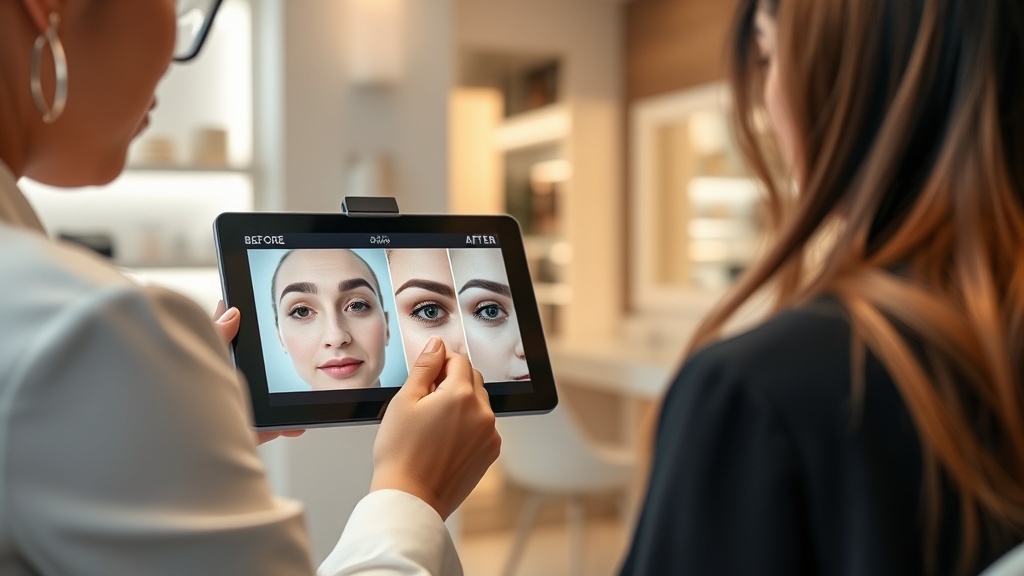
This does two things. It validates their taste while simultaneously showing them a realistic equivalent. It also builds immense confidence in your skills. They can see you have a proven track record of delivering beautiful, lasting results. Make sure your portfolio is easily accessible, ideally on a tablet or large screen in your studio, so you can swipe through high quality images together.
Redirecting the Conversation: Scripts for Handling Impossible Demands
Sometimes, despite your best efforts, a client remains fixated on an impossible outcome. They want their brows moved an inch higher, or a shape that defies their natural muscle structure. In these moments, you need to be prepared with clear, firm, and professional scripts. You are not being difficult; you are protecting them from a bad result and protecting your own professional integrity.
Here are a few phrases you can adapt:
- “I understand that you love that shape, but based on your natural brow bone and muscle movement, placing the brow there would unfortunately lead to an unnatural look as you make different expressions. My priority is to give you a result that looks beautiful and natural all the time.”
- “That filtered photo is beautiful inspiration for the overall feel. For your skin type and to ensure the strokes heal cleanly without blurring, we will need to design a shape that is slightly softer. I can draw it on for you now to show you how stunning it will look.”
- “As a professional, I have a duty of care to give you the best possible result that will age well over time. I cannot in good conscience create a shape that I know will not be flattering or will look unnatural. However, I am confident we can create a shape you will absolutely love that works with your unique features.”
The key is to always bring it back to your professional expertise and your commitment to their best interests. Frame it as you protecting them, not you denying them.
Using Technology to Your Advantage: How Your CRM Can Help
Managing these detailed consultations and client journeys is a lot to juggle. This is where having a robust system in place becomes invaluable. A dedicated CRM designed for salon professionals, like our Scale My Salon platform, can be a game changer.
Within the CRM, you can keep detailed notes from every consultation. You can document that you discussed realistic expectations and showed examples of healed work. You can even upload the inspiration photos they brought, alongside the pre draw photos and the final results. This creates a comprehensive record of the entire process, protecting you in the event of any future disputes. It’s a professional way to document that you have done your due diligence.
Having this system in place, as many PMU Society members do, frees up your mental energy to focus on the client in front of you. You can be fully present and confident during the consultation, knowing that all the important details are being securely and professionally managed in the background. It elevates your business from a simple service to a seamless, professional experience.
Ready to Fill Your Calendar?
PMU Society has helped over 100 permanent makeup artists build thriving, fully booked businesses. We generate over 2,000 bookings every single month. Let us do the same for you.
Get Started Today